Criminal Records in Kane County can be retrieved in minutes through the Illinois State Police Bureau of Identification portal, where conviction details are publicly available. A simple Kane County criminal record search returns a certified copy that lists offense type, sentencing and current status. Fees range from $12 to $15 for the state request and $5‑$10 for county certification, with most results delivered within one to five business days.
Criminal Records searches also let you locate Kane County criminal case records by name, case number or date of birth, helping avoid duplicate or outdated entries. The online system flags sealed or expunged files, so you know when information is restricted. If a record appears missing, contact the county clerk to verify the criminal case status and request an official copy. This approach ensures reliable verification for landlords, employers and families.
How to Search Criminal Records
Criminal records are official court and state history entries that connect a person with convictions and, for a particular case, charges, case status, and sentences. A kane county criminal record lookup can help locate a criminal case number, verify an offense, or obtain a copy for a lawful purpose. The Illinois State Police Bureau of Identification handles the statewide criminal-history request, and the Kane County circuit court clerk holds records for specific county court cases. These sources answer different questions, so start with the one that matches the result you need.
Official Search Portal: https://isp.illinois.gov/BureauOfIdentification/CriminalHistory
Steps to Search
- Open the Illinois State Police Bureau of Identification page and select the Criminal History Request option.
- Complete the current form with the subject’s legal name and each identifier the form requests. Add an alias only if the form asks for alias data.
- Choose the request type and payment method shown on the official page, then check the spelling of the name and date of birth.
- Submit the request with the required fee and keep the receipt or confirmation.
- After the criminal history arrives, compare its case number, county, offense, and conviction date with any court paper. Use the county court clerk for missing case-level details.
What Each Criminal Record Source Shows
A criminal record search can draw from several record systems. Each system documents a different event, so a result from one source may not answer a question about another.
State and County Records Serve Different Purposes
The ISP response shows the conviction details Illinois can release for the named person. The county file shows what happened in one court case, such as the charge filed, any plea, the court’s decision, and the sentence entered. A county case can be pending or end without a conviction, so it may have no entry in the public ISP result. A conviction can appear in state history even when the requester needs a certified copy of a particular court decision.
Pick the Source by the Needed Result
Use the ISP request for a statewide criminal-history check within its public scope. Use the Kane County circuit court clerk for a case number, current case status, charge sheet, judgment, or certified sentence copy. A police arrest report, jail record, or private screening report answers a separate question and should not be labeled as a certified criminal history.
Criminal Record Search Fields and Match Checks
The exact fields depend on the selected request. A full legal name, date of birth, case number, and county can help narrow a person-level or case-level search. Use each field listed by the official form rather than guessing which terms the source accepts.
- Full legal name: Use the name shown on a court paper or other reliable record, including any middle name or suffix.
- Date of birth: Match the date exactly, since a common name can belong to more than one person.
- Case number: Use the number printed on a citation, charging document, summons, or court notice.
- County and court: Confirm the county and court that handled the case, since case numbers may repeat across jurisdictions.
- Charge or offense class: A felony or misdemeanor label can help locate the correct case, but the court outcome still needs review.
- Known aliases: Supply an alias only when the official request form asks for it or when an older court record uses that name.
Use the Most Precise Identifier Available
A case number is usually more precise than a name because each court case receives its own number. A name search should include every identifier the form allows. If a court notice lists a case number, save it before requesting the county record. That number lets the clerk locate the correct file and reduces the chance of choosing a person with the same name.
Confirm Each Match Before Continuing
Compare the name, date of birth, county, and case number before reading the rest of a result. Stop and request a clearer source record if one of those fields conflicts. Do not rely on the first result that appears, since a common name, alias, or incomplete date can create a false match.
Kane County Criminal Case Record Contents
A Kane County criminal case record may contain the following items. The exact set depends on the case, the records held, and the document availability rules for that file.
- Case identifiers: County, court, case number, and filing date.
- Party and appearance details: Names and appearances connected to the court case.
- Charge documents: Offense description, felony or misdemeanor classification, and alleged acts stated in the charging paperwork.
- Case events: Pleas, hearing entries, status entries, and the court disposition.
- Judgment and sentencing records: Probation, incarceration, fines, restitution, and other ordered conditions.
- Case closure records: Documents showing whether the case ended by conviction, dismissal, acquittal, or another court decision.
Completed Case Documents
For a completed case, a certified judgment or sentencing order can show the charge, court decision, sentence, and probation conditions. Availability depends on what the court filed and the copy procedure used by the clerk. A criminal-history response can show the state’s conviction record, but the certified county documents provide a stronger source for the exact court wording.
Case Status From the Clerk
The clerk’s index can show whether a known Kane County case is pending, active, or closed. An index entry is a starting point for a request, not a replacement for a certified document when the exact ruling or sentence must be established. A pending case can later produce a different record than the status shown on an earlier index search.
Offense Details and Case Status
Accurate criminal record review separates the event that started a case from the event that ended it. An arrest, a filed charge, a conviction, a sentence, and a later court decision each have a separate meaning. The source used for the search must match the event being confirmed.
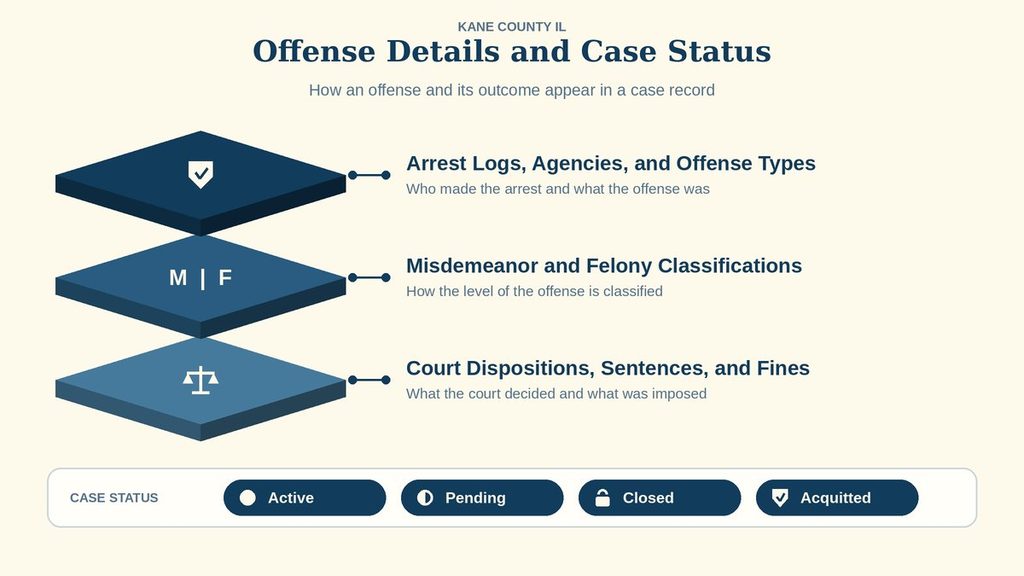
Arrest Logs, Agencies, and Offense Types
An arrest log records that police took someone into custody. A charge is a legal accusation filed by a prosecutor. A conviction follows a plea of guilt or a court finding of guilt. Under the public-release rule for the ISP criminal-history request, an arrest with no conviction remains outside the standard public response. A county case file may identify the arresting agency and include charging documents that describe the alleged offense.
Misdemeanor and Felony Classifications
Felonies and misdemeanors are legal classifications of charges. A felony charge can end in dismissal or acquittal, and a case charged as a felony can end with a conviction for a misdemeanor after a plea. The classification shown in a search result does not prove the court’s final outcome. Read the charge as filed and the court decision entered before labeling a person with a conviction.
Search phrases for felony records or misdemeanor records can bring up cases by the charge named in the case file. That charge may have been changed by a plea or other court decision. A felony search may therefore include a misdemeanor conviction, and a misdemeanor search may include a dismissed case. Confirm the offense, classification, and disposition together.
Court Dispositions, Sentences, and Fines
A court disposition states how the case ended. Sentencing can include probation, incarceration, a fine, restitution, or other conditions ordered by the court. The ISP response can show the conviction and sentence data present in the state record. A certified county judgment or sentencing order gives fuller proof of the terms entered by the court.
A fine has two separate parts: the amount ordered and the payment status. The court file may show the amount imposed, while payment records may be held by the office that receives those payments. Do not treat the absence of a payment notation as proof that a fine remains unpaid. Do not infer that jail time was imposed from the felony label alone, since the sentence entered by the court controls.
Active, Pending, Closed, and Acquitted Cases
An active or pending case has no final outcome yet. It may not have created a public ISP conviction entry. A closed case has ended, but closure alone does not show a conviction. An acquittal means the court did not find the person guilty, and a dismissal means the case ended without a conviction on that charge.
Some cases contain several charges. One count can be dismissed and another count can lead to a conviction. Read each count and the court’s decision rather than treating the entire case as one event. The clerk’s current index and a certified disposition document can establish the exact status.
Public Availability and Official Copies
Public availability depends on the record type, the subject of the request, and the legal status of the case. The state criminal-history request and a county-certified court copy perform different tasks. Their fees, delivery methods, and processing times should be reviewed separately.
The fee ranges cover separate services. A state request fee applies to the ISP criminal-history response, and a county certification charge applies to a court document requested from the clerk. Fees and processing times can change, so check the current official request page and the clerk’s copy instructions before paying. The one-to-five-business-day estimate applies to most online requests and does not cover every manual or archived request.
Public Directory and Case-Specific Files
The state request produces a person-level criminal-history response. It does not supply every file listed in the court clerk’s public directory. County records remain tied to a specific case, charge, judgment, or other document. A requester who needs the wording of a court decision should use the county copy process rather than expecting the state response to reproduce the complete file.
Sealed, Expunged, and Juvenile Exclusions
Public release through the ISP request is limited to conviction details under Illinois law. To assist researchers, official criminal history documentation shows that sealed records, expunged records, and juvenile records follow separate rules and are not part of the standard public request. A completed sentence does not by itself erase a conviction, and not every conviction qualifies for expungement. A legal change can affect public availability only through the proper court or agency process.
A no-match result does not prove that a record is sealed, expunged, or juvenile. The case could be pending, based on an arrest without conviction, recorded under another name, or missing from the state response because of a reporting delay. Verify the case number and county before drawing a conclusion from an empty search.
Court and Agency Requests
A court, prosecutor, police agency, or another authorized party may use records through a role-specific process. The standard public request does not grant permission to inspect restricted material. Provide the case number and legal role when seeking a court record, then follow the form and authorization rules set by the receiving office. A request made through the wrong process can delay the record without producing the needed document.
Certified Copies, Fees, and Delivery
A certified copy carries authentication from the office that holds the record. A search-result screen, downloaded document, or private screening report is not automatically certified. Ask the receiving party whether a certified copy is required and which copy type and format it accepts before ordering. The ISP request can produce a state record, and the county clerk can certify a case document for use when official proof is needed.
Keep the request receipt, report date, and document identifiers with each copy. If delivery fails or arrives without the requested certification, contact the source office that produced it rather than placing the document into service. A prompt delivery estimate is not the same as confirmation that the copy contains the required court details.
Record Accuracy and Resolution
Accuracy checks are most valuable when a name is common, a case is old, or the state response and county file appear to differ. Keep the source documents so each correction can be traced to the agency that supplied it.
- Identity: Confirm the full legal name, date of birth, and any alias used by the court.
- Case link: Confirm the county, court, and case number.
- Event: Separate the arrest, filed charge, conviction, sentence, and case disposition.
- Dates: Compare the offense date, conviction date, sentencing date, and report date.
- Source: Record the agency that supplied each result and the date the copy was produced.
- Copy status: Note whether the copy is an ordinary search result or a certified record.
Resolve Similar Name Matches
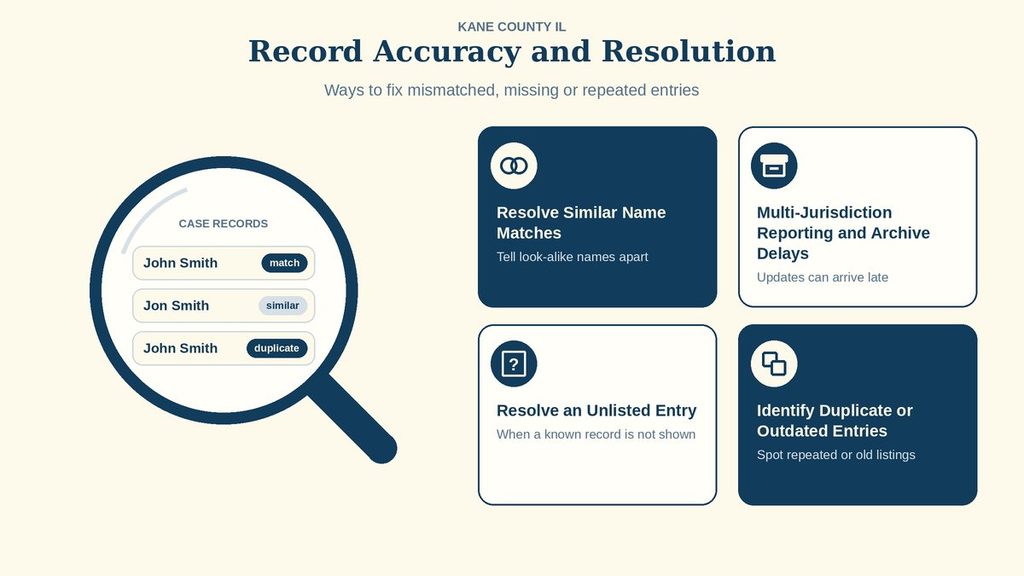
A name-only match can point to a different person, or the same person under an alias. Date of birth can rule out a false match, while a court case number can connect the result to the correct case file. If the name and date of birth fit but the county does not, check for another case before proceeding. Never merge two entries based on name alone.
Multi-Jurisdiction Reporting and Archive Delays
State criminal history and county court records operate through separate reporting paths. A new case may appear in the county file before the statewide response reflects it. Older records may sit in an archived file or require a different request method. This creates a timing gap that does not prove that the case or conviction is absent. Searching by county and case number can narrow the source request during this gap.
Resolve an Unlisted Entry
Start by repeating the state request with the exact legal name and date of birth shown on older records. If a court notice provides a case number, request the indexed case and certified disposition from the Kane County circuit court clerk. Compare the name, date of birth, county, case number, offense, and dates across both records. If the county file shows a conviction missing from the state response, provide the county case details when asking the ISP to trace the state report. If the state response names a case that the county index does not show, ask the clerk to search archived records and reconcile any spelling changes. Keep both documents until the difference is resolved.
Identify Duplicate or Outdated Entries
Two entries with the same name can represent two court cases, one case recorded under an alias, or duplicate reporting. The case number is the strongest way to separate them. A response produced before a later court decision can also be outdated, so check the report date and obtain a current certified disposition when the outcome matters. Do not remove, merge, or rely on an entry until the source records support that action.
Privacy and Responsible Use of Criminal Records
Public release of conviction details does not grant unlimited permission to use or share a criminal record. The purpose, source, date, and certification level should match the decision for which the record was requested.
Public Record Scope and Lawful Use
Keep the ISP criminal-history response, court case documents, arrest records, and private screening reports distinct. A charge or arrest is not proof of a conviction. For employment, housing, licensing, or another lawful purpose, confirm whether the receiving party requires a state request, a county-certified document, or a report from a permitted screening provider. Third-party reports can contain more than the public ISP result, so review the included fields before using them.
Make a Decision From a Current Record
Before relying on a result, confirm the person’s identity, the source date, the court disposition, and the required copy type. If the result conflicts with the person’s account or another document, request a current certified record and document the discrepancy before taking action. Keep a clear log of request dates, agencies, case numbers, and corrections. That record makes the review easier to repeat if the case changes later.
Sealed, expunged, and juvenile matters require their own legal process. A standard public request should not be used to seek restricted records outside that process. For a Kane County criminal case, collect the exact case number first. It gives the clerk the clearest path to the requested document and reduces errors caused by a common name or incomplete identifier.
Contact Information
Use the official Illinois State Police contact page for Bureau of Identification questions about a state criminal-history request. The department can provide information about available background-check procedures, submission requirements, and related records. Review the current instructions before contacting the office to identify the correct service. For accurate contact details and assistance, refer to the Illinois State Police website.
- Address: 260 North Chicago Street, Joliet, IL 60432-4075
- Phone: (815) 740-5160
- Official contact page: https://isp.illinois.gov/Home/ContactISP
Frequently Asked Questions
Criminal records show a person’s convictions, case numbers and sentencing details. Accessing these files helps landlords, employers and citizens verify legal status, protect safety and meet licensing rules. In Kane County, the official source is the Illinois State Police Bureau of Identification, while local courts hold case‑specific files. Knowing how to request, read and interpret these documents saves time and avoids costly mistakes.
How can I request a Kane County criminal record online?
Visit the Illinois State Police Bureau of Identification portal, select “Criminal History Request,” and fill out the online form. You will need the applicant’s full name, date of birth and, if available, case number. Pay the state fee with a credit card, then submit. The agency emails a PDF copy within 10‑14 business days. This route is the fastest way to obtain an official record for employment, housing or legal purposes.
What information does a public criminal record in Kane County include?
A public record lists convictions, felony or misdemeanor classifications, sentencing dates, probation terms and court locations. It does not show arrests without conviction or sealed cases. The record also notes the case disposition—guilty, dismissed or acquitted—so users can see the final outcome. This level of detail satisfies most background‑check requirements.
Can I search criminal records by case number in Kane County?
Yes. Enter the case number on the Kane County Circuit Court clerk’s website under “Case Search.” The system returns the docket, charge details and any available sentencing information. If the case is older than five years, you may need to request a certified copy via mail. Using the case number narrows results and reduces confusion with similar names.
Why might a criminal record search return no results?
No results appear when the individual has no convictions, when the record is sealed or expunged, or when the name spelling differs from the official filing. Verify the exact legal name, include middle initials, and check alternative spellings. If the person was charged but never convicted, the public database will not list the incident.
What are the fees and processing times for a certified criminal record copy in Kane County?
The state charges $22 for a standard criminal‑history request and $30 for a certified copy. Processing usually takes 10‑14 business days for electronic delivery; mailed copies add 3‑5 days. Expedited service costs an extra $15 and delivers within 3‑5 business days. Paying the correct fee and providing complete personal data speeds up the entire process.